

Late morning is one of those everyday phrases people use without thinking twice—until someone asks exactly what it means. Whether you are planning a meeting, scheduling a delivery, or organizing your day, knowing where late morning begins and ends helps you communicate more clearly and plan more effectively.
What Time Is Late Morning?
Late morning is the final stretch of the morning, arriving after mid-morning and ending at noon. Most people agree it covers roughly 10:30 AM to 12:00 PM, with 11:00 AM sitting comfortably at its center.
There is no single official rule that everyone follows. However, in everyday conversation, professional scheduling, and social planning, this time range is widely recognized and consistently used.
When Does Morning Itself Start?
It’s worth noting when does morning start in the first place: most schedules treat 5:00 AM as the earliest point of early morning, though this shifts with sunrise time and personal routine. Everything from that point through 11:59 AM falls under the umbrella of “morning,” with late morning as its final stretch.
Morning Time Phases at a Glance
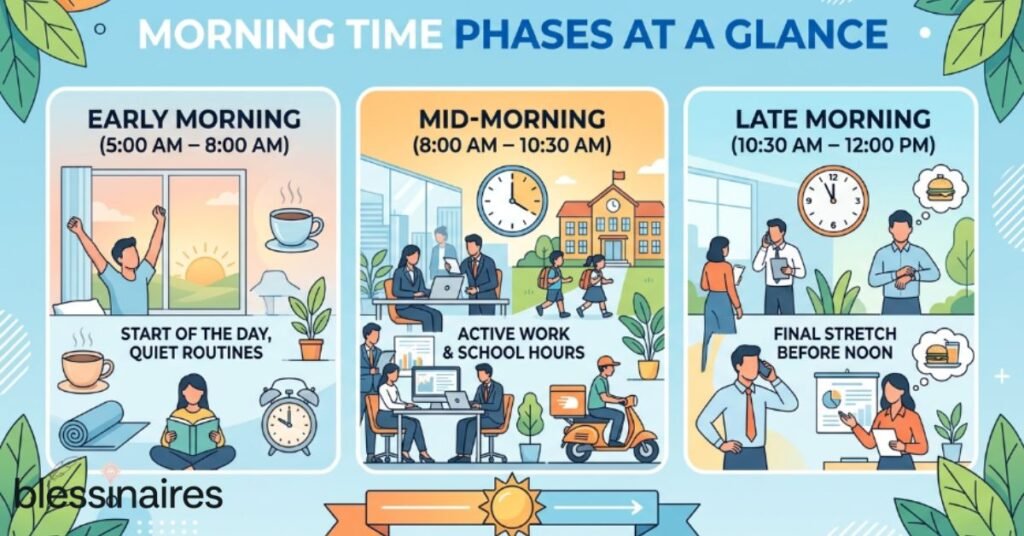
| Morning Phase | Common Time Range | General Meaning |
| Early Morning | 5:00 AM – 8:00 AM | Start of the day, quiet routines |
| Mid-Morning | 8:00 AM – 10:30 AM | Active work and school hours |
| Late Morning | 10:30 AM – 12:00 PM | Final stretch before noon |
What Is the Late Morning Time Range Exactly?
People often search for the exact late morning time range to use in scheduling, invitations, or professional communication. The most widely accepted range is 10:30 AM to 12:00 PM. If you need a single representative hour, 11:00 AM is the clearest example of late morning time.
For those asking what time is late morning in a specific context — such as a doctor’s appointment, a delivery slot, or a business call — any booking between 10:30 AM and 11:45 AM safely falls within late morning hours. The phrase late morning timing signals that the event happens in the final stretch of the morning, before the noon transition.
A quick reference: late morning times start where mid-morning ends (around 10:30 AM) and close at noon (12:00 PM). Anything at or after 12:00 PM is afternoon — not late morning.
What Does Late Morning Actually Mean?

Late morning means the day is fully underway, the early rush has passed, and noon is approaching. It is a phrase people reach for when they want to communicate approximate timing without committing to an exact hour.
Saying “I will call you in the late morning” sets a clear general expectation—the call will come before noon but not first thing after waking up.
Is 11 a.m. Late Morning?
Yes, without question. 11:00 AM is the clearest and most universally accepted example of late morning. The day is well started, noon is close, and the phrase fits perfectly.
Is 10:30 a.m. late morning?
Generally, yes, though some people still consider 10:30 AM to be the tail end of mid-morning. It sits on the border between the two phases. In most practical contexts—work emails, event planning, and social arrangements—10:30 AM is treated as the beginning of late morning.
Is 10 AM Late Morning or Still Mid Morning?

One of the most searched questions is: is 10 AM late morning? The answer depends slightly on context. At exactly 10:00 AM, you are at the boundary between mid-morning and late morning. Most scheduling guides treat 10:00 AM as the beginning of late morning — though some still consider it the tail end of mid-morning.
Is 10am considered late morning? In practical terms — for appointments, business communication, and daily planning — yes. If someone says they will arrive in the late morning, 10:00 AM is the earliest reasonable interpretation of that window. By 10:30 AM, the transition is complete and you are firmly in late morning.
For those wondering about what is mid to late morning: this phrase refers to the overlap zone of roughly 10:00 AM to 11:00 AM — when mid-morning gives way to late morning. It is a common phrase used when someone wants to indicate flexibility within that transition window.
Is 11 AM Considered Morning or Afternoon?
Yes — 11:00 AM is firmly morning. The question is 11 AM late morning has a clear answer: it is the most universally accepted example of late morning. The day is well underway, noon is close, but 11 AM has not crossed any boundary into afternoon.
Is 11am late morning? Absolutely. 11 AM sits squarely in late morning time and is not yet afternoon. Noon at 12:00 PM marks the transition — so 11 AM is late morning by every standard scheduling definition. An 11 o’clock late morning definition simply means: it is still morning, in the final hour before noon.
Is 12 PM Late Morning?
No. 12:00 PM marks noon, which is the transition point from morning to afternoon. Even if it feels like a natural extension of the morning, most schedules, formal systems, and everyday conversations treat 12 PM as the start of the afternoon—not late morning.
Once the clock strikes noon, the day shifts into a new rhythm entirely — and it’s a great moment to pause and share some 230+ Good Afternoon Blessings with the people you care about as their morning winds down.
What Time Does Morning End and Afternoon Begin?

A direct question many people ask: when does afternoon start? The answer is 12:00 PM noon. Morning — including early morning, mid-morning, and late morning — covers the full span from roughly 5:00 AM to 11:59 AM. At 12:00 PM, the morning vs afternoon boundary is crossed.
For scheduling purposes, what time is considered morning ends at noon. A meeting at 12:00 PM is technically an afternoon meeting. A call at 11:45 AM is still a late morning call. Understanding this boundary helps answer what what time is late in the morning means: it is the 11:00 AM to 11:59 AM window — the final hour before noon arrives.
People also ask about what is considered late morning early afternoon — a phrase that refers to the transition zone between roughly 11:30 AM and 12:30 PM, when morning is ending and afternoon is beginning. This overlap period often involves lunch plans or a wrap-up of morning tasks.
Late Morning vs Mid Morning — What Is the Difference?
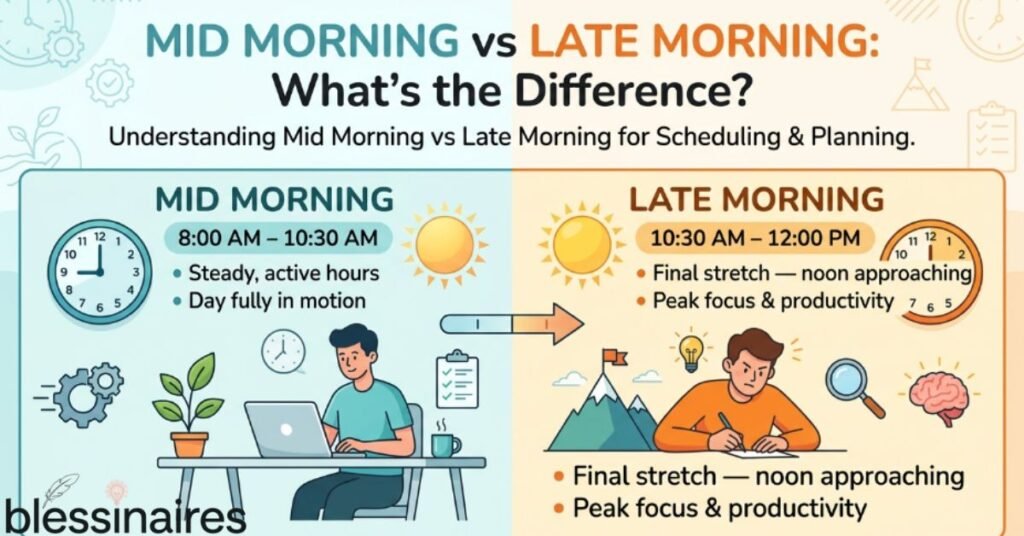
Understanding mid morning vs late morning helps clarify scheduling language and everyday planning.
| Phase | Time Range | Key Characteristic |
| Mid-Morning | 8:00 AM – 10:30 AM | Steady, active hours — day fully in motion |
| Late Morning | 10:30 AM – 12:00 PM | Final stretch — noon approaching, peak focus |
Mid-morning runs from approximately 8:00 AM to 10:30 AM — a period of active, steady work and routine. Late morning follows from 10:30 AM to 12:00 PM, carrying a sense that the day’s first half is nearly complete.
When someone asks what is considered mid morning or whats considered mid morning: it is the block from 8:00 AM to 10:30 AM. When someone asks what is considered mid-morning for a specific appointment or task — it is any slot within that 8–10:30 AM window, distinct from the late morning hours that follow.
Early morning prayer and reflection — such as reading African American Sunday blessings — naturally extend into a peaceful and focused late morning.
Late Morning Definition — What the Term Officially Means

There is no single late morning definition dictionary entry that every source agrees on. However, across usage guides, style references, and scheduling tools, the definition of late morning is consistent: it is the period from approximately 10:00 AM to 11:59 AM, immediately before noon.
If you search for a Merriam-Webster late morning definition, you will not find a dedicated entry — the dictionary does not formally define time-of-day phrases like late morning. Instead, usage establishes meaning. Across news writing, appointment systems, and everyday speech, late morning reliably describes the late morning hours from 10:30 AM to noon.
The meaning of late morning can also be understood through contrast. Early morning means before most people have begun their day. Mid-morning means the active, steady middle hours. Late morning means the morning is winding down — noon is near, and the first half of the day is approaching its close. That is the simplest and most accurate late morning definition available.
For those looking for a late morning synonym: common alternatives include late AM, pre-noon hours, late-morning (hyphenated form), and the phrase mid to late morning when referring to the 10:00–11:00 AM overlap window. The term later morning meaning refers to the same window — the final hours before noon.
How Sources Define Late Morning
Reference sources generally agree on the same window. Britannica’s dictionary places late morning between roughly 11:00 AM and noon, while other language references anchor it closer to the 10:00 AM to 12:00 PM range used throughout this guide. This convergence across independent sources is part of why the 10:30 AM to 12:00 PM window is treated as the standard definition rather than a personal preference.
What Is Considered Late Morning? A Practical Guide
When people ask what is considered late morning, whats considered late morning, or what would be considered late morning — the answer is consistent: the hours from 10:00 AM (or 10:30 AM) through 11:59 AM. This is also what is meant by what is classed as late morning in British English usage.
For specific contexts:
- For appointments: late morning slots are typically 10:30 AM to 11:45 AM
- For deliveries: a late morning delivery window usually means arrival by noon
- For meetings: late morning scheduling refers to 10:00 AM to 12:00 PM
- For social plans: late morning brunch or visits generally start at 10:00 AM or later
The phrase late morning hours is the most common way to describe this window collectively. Whether someone says late mornings (plural, as in a recurring routine) or simply late morning (singular, for a specific event), the time reference is the same: the final active stretch before noon.
People also ask: what is late morning called in other terms? Common alternatives include late AM, pre-noon hours, late-morning (hyphenated), and mid to late morning for the transition zone. The late AM meaning is the same as late morning — the hours approaching noon, typically from 10:30 AM onward.
Cultural and Regional Variations in Late Morning

Time phrases are not universal. Different cultures, climates, and daily rhythms shape how people define and experience late morning in meaningful ways.
Global Interpretations of Morning Phases
In some regions, late morning can begin closer to 10:00 AM. In others, the morning itself starts later due to lifestyle patterns, climate, or local customs, which can push the entire schedule forward.
A person who wakes at 5:00 AM for farm work may consider 10:30 AM fully midday. A person whose workday begins at 10:00 AM may still consider 11:30 AM early in their productive hours. Language and lived experience grow together, which is why flexible time phrases like late morning remain so durable.
Societal Influences on Time Perception
School hours, office start times, public transport schedules, and even local meal customs all shape how people think about parts of the day. In fast-moving urban environments, late morning often feels like peak activity time. The same hours might seem serene and leisurely in slower or more rural communities.
Cultural Norms Around the World
In some countries, late morning is considered ideal for business calls and professional meetings. In others, it sits uncomfortably close to a longer midday break or lunch period and may be treated as an informal or transitional window. Understanding these differences matters especially in global communication and cross-cultural scheduling.
Late Morning in Professional Contexts
In work settings, late morning consistently ranks among the most productive and valued time blocks of the day. This period commonly schedules meetings, client calls, presentations, and focused project work.
Common Late Morning Mistakes to Avoid
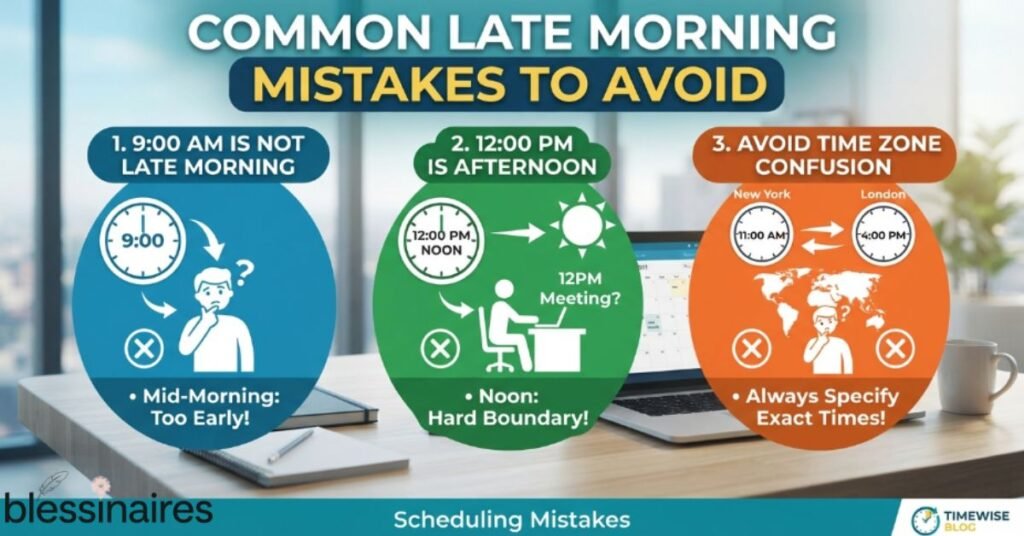
A few mix-ups come up often enough to call out directly:
• Assuming late morning starts at 9:00 AM. 9:00 AM is firmly mid-morning. Most calendars and scheduling tools don’t treat a slot as late morning until 10:00 AM at the earliest.
• Treating 12:00 PM as still “morning.” Noon is the hard boundary. A 12:00 PM meeting is an afternoon meeting, even if it feels like a natural extension of the morning.
• Saying “late morning” across time zones without a clock time. What is late morning for you may be evening or the middle of the night for a colleague elsewhere — always pair the phrase with an exact time when the audience spans locations.
Keeping these three in mind is usually enough to avoid the scheduling confusion that makes people search for what time is late morning in the first place.
Business Communication and Scheduling
Vague time phrases can occasionally create confusion in professional settings. A message that reads “Let’s connect in the late morning” works well between colleagues who know each other’s routines. In more formal or international contexts, pairing the phrase with an exact time removes any uncertainty.
For example, “Let’s connect in the late morning—does 11:00 AM work for you?” keeps the natural, conversational tone while ensuring clarity for everyone involved.
Industry-Specific Interpretations
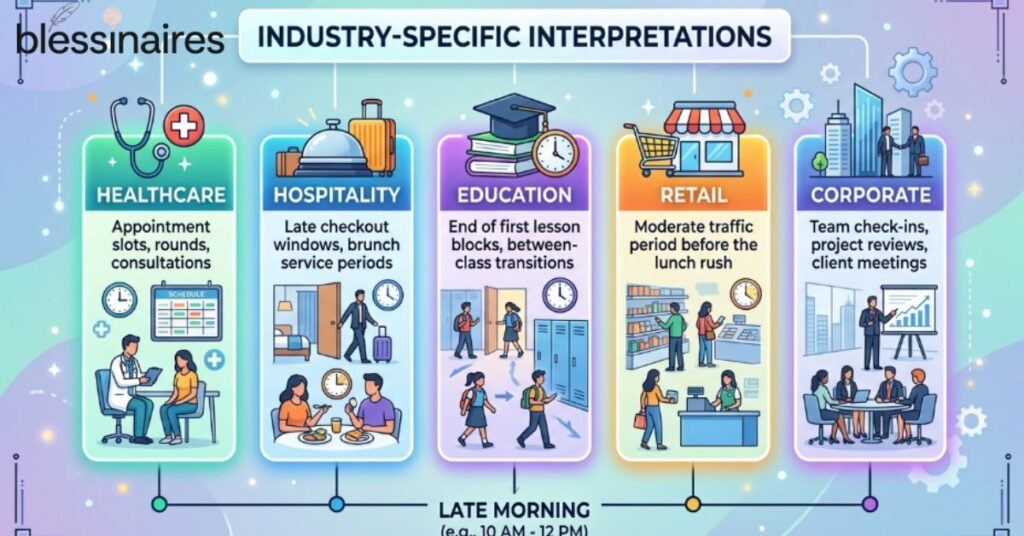
Different industries use late morning in ways shaped by their rhythms and demands.
| Industry | How Late Morning Is Often Used |
| Healthcare | Appointment slots, rounds, and consultations |
| Hospitality | Late checkout windows, brunch service periods |
| Education | End of first lesson blocks, between-class transitions |
| Retail | Moderate traffic period before the lunch rush |
| Corporate | Team check-ins, project reviews, client meetings |
Early Morning vs. Mid-Morning vs. Late Morning
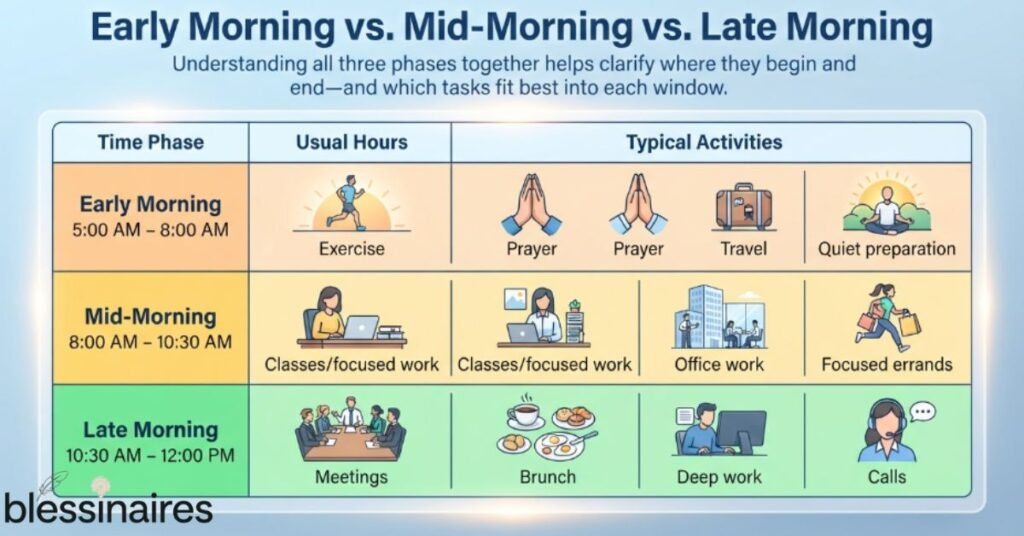
Understanding all three phases together helps clarify where they begin and end—and which tasks fit best into each window.
| Time Phase | Usual Hours | Typical Activities |
| Early Morning | 5:00 AM – 8:00 AM | Exercise, prayer, travel, quiet preparation |
| Mid-Morning | 8:00 AM – 10:30 AM | Classes, office work, focused errands |
| Late Morning | 10:30 AM – 12:00 PM | Meetings, brunch, deep work, calls |
The energy of each phase tends to differ noticeably. Early morning feels fresh and still. Mid-morning carries steady momentum. Late morning often feels both productive and slightly anticipatory—the day is in full motion, and something (usually lunch, a break, or a transition) is approaching.
Biological Rhythms and Late Morning Performance
Biology underpins the widespread appreciation for late morning as a prime time for important tasks. The body’s natural alertness cycle—the circadian rhythm—tends to support strong mental performance during this window for many adults.
Circadian Rhythms and Cognitive Performance
Circadian rhythms are the internal clock systems that regulate sleep, wakefulness, mood, and mental sharpness throughout every 24-hour cycle. For a significant portion of adults, alertness rises steadily through the morning and reaches a useful peak somewhere between 10:00 AM and 12:00 PM.
This biological pattern explains why many people find decision-making, creative thinking, and focused learning easier during late morning than at almost any other time of day.
Making the Most of Late Morning Energy
Knowing that your brain is often at its sharpest in late morning is useful information. Matching your most demanding tasks to this window — rather than filling it with low-effort activities — can meaningfully improve both output and satisfaction.
Productive Late Morning Habits
- Schedule deep work, writing, and problem-solving before noon
- Hold important meetings or calls during this high-focus window
- Batch communications — emails, messages, updates — into one clear block
- Save routine or low-priority tasks for lower-energy afternoon periods
- Protect the window from unnecessary interruptions when possible
Many people incorporate short spiritual moments into their late morning routine, and reading African American Tuesday blessings is one popular way to do so.
Pairing your late morning work session with meaningful good morning life quotes can help maintain focus and motivation through the final hours before noon.
If you want to carry that same focus and positivity into the rest of your late morning, a few 330+ Heartfelt Good Morning Quotes for a Positive Mind can be a simple way to reset your mindset before diving back into deep work.
Late Morning Routines Across Different Lifestyles

Late morning does not look the same for everyone. Daily routines, work structures, personal responsibilities, and life stages all influence how people utilize this period.
| Lifestyle | Common Late Morning Activities |
| Student | Classes, study sessions, assignment review |
| Office Worker | Team meetings, project updates, reports |
| Freelancer | Deep work blocks, client calls, planning |
| Parent | School runs, errands, appointments, home tasks |
| Retiree | Morning walks, hobbies, social visits, leisure |
It’s more important to understand how late morning fits into your rhythm and use it intentionally than to match a universal standard.
For those who find meaning in daily rituals, starting with good morning Tuesday blessings can make the late morning hours feel more intentional and grounded.
Similarly, sharing good morning Thursday blessings with loved ones is a simple late morning habit that many people build into their weekly routine.
Practical Examples of Late Morning in Daily Life
The phrase appears constantly in everyday planning, both formal and casual.
- “Let’s meet in the late morning, maybe around 11.”
- “Your delivery is expected by late morning.”
- “I do my best writing in the late morning before lunch.”
- “The appointment is scheduled for late morning.”
- “Brunch works — late morning is perfect for us.”
Each example shows the phrase doing exactly what it was designed to do: communicate a general time window without requiring rigid precision.
Seasonal and Geographical Variations
Late morning can feel noticeably different depending on where you are and what time of year it is.
How Seasons Affect Late Morning
In winter months, late morning may genuinely feel like the true beginning of active daily life. Light arrives later, temperatures are lower, and people often start their day more slowly. By contrast, late summer mornings can feel almost midday in their energy—bright, warm, and already well into the rhythm of the day.
These seasonal differences are more pronounced at higher latitudes, where daylight hours vary dramatically across the year.
How Geography Shapes Time Perception
Urban environments tend to make late morning feel busy and fast-moving—streets are active, meetings are already underway, and the approaching lunch period creates a sense of momentum. In rural or quieter settings, the same hours may feel more spacious and relaxed.
People living near the equator experience relatively consistent sunrise and sunset times year-round, which tends to create more stable daily rhythms. Those in northern or southern regions may experience significant seasonal shifts in how morning phases feel and function.
Late Morning Across Time Zones and Global Teams

In international work, late morning becomes more complex. What is 11:00 AM for one team member can be late evening, early morning, or the middle of the night for a colleague in another country.
Coordinating Across Time Zones
Global teams benefit from specific, unambiguous time communication. Saying “late morning” without specifying a time zone and location can result in missed meetings and unnecessary confusion.
Clear International Scheduling Habits
- Always include the specific time alongside any general phrase
- State the time zone clearly in every cross-border communication
- Confirm the local time for all attendees before finalizing schedules
- Use shared calendar tools that automatically adjust for time zone differences
- Never assume that late morning carries the same meaning for everyone on the call
Psychological and Emotional Aspects of Late Morning

Late morning is not just a point on a clock. It carries a distinct psychological texture for many people—a feeling of the day being in motion without yet feeling heavy or exhausted.
Mood and Mental Patterns
For many adults, mood improves steadily through the morning as sleep inertia fades and daily routines take hold. By late morning, many people feel alert, settled, and reasonably comfortable in their day. This makes it a naturally good window for social interaction, collaborative work, and tasks that require both energy and patience.
Thinking Clearly in Late Morning
Memory recall, attention span, and analytical reasoning tend to be more reliable in the late morning for a large portion of adults. This biological reality supports the common practice of scheduling important intellectual work—meetings, writing, planning, and learning—before noon rather than after.
If you are looking for inspiration to begin your late morning with positivity, exploring African American good morning quotes can set a uplifting tone for the hours ahead.
The Future of Late Morning as a Concept

Remote work, flexible scheduling, and global collaboration have already begun to shift how people experience and define parts of the day. For workers who set their own hours, late morning may start at different clock times depending entirely on when their day begins.
Even as these patterns evolve, the underlying concept — the final active stretch before noon — will remain a useful and recognizable part of how people talk about time. Natural language phrases like “late morning” survive not because they are precise, but because they are human and immediately understandable.
Smart devices, AI scheduling assistants, and global calendar tools will continue making time coordination more exact. But a simple phrase that communicates a general window without demanding precision is unlikely to lose its value.
Historical Perspective on Morning Time Divisions
Long before mechanical clocks existed, people divided the day by sunlight, prayer rhythms, and the natural structure of work. Morning was understood to shift from early to late based on the position of the sun and the advancement of daily activity.
As timekeeping became more precise—from sundials to mechanical clocks to digital devices—phrases like “late morning” became easier to connect to specific hours. Even so, the human preference for flexible, approximate time language persisted. We have always found it more natural to say “late morning” than to say “between 10:47 and 11:58 AM.”
Conclusion
Late morning generally covers the hours between 10:30 AM and 12:00 PM, with 11:00 AM as its clearest and most widely recognized midpoint. It signals that the early part of the day has passed, the afternoon has not yet arrived, and the time ahead is often well-suited for focused, high-value activity.
While exact boundaries shift by culture, lifestyle, and context, the phrase remains one of the most universally understood time expressions in everyday communication. Use it with confidence — and pair it with a specific time whenever clarity really matters.
Frequently Asked Questions
1. What time is considered late morning according to most people?
Late morning is generally considered to be between 10:00 AM and 11:59 AM. It’s the window just before noon when the morning is winding down and midday is approaching.
2. What is the difference between early morning, mid-morning, and late morning?
Early morning runs are from 5 to 8 AM, mid-morning from 8 to 10 AM, and late morning from 10 AM to noon. Each phase marks a different stage of the day’s first half.
3. Is 11 AM considered late morning or almost noon?
Yes, 11 AM is considered late morning—it sits in the final stretch of the morning hours. While it’s close to noon, it still falls within the late morning timeframe of 10–11:59 AM.
4. Can late morning mean different things in different countries or cultures?
Yes, it can vary slightly. In most Western cultures, late morning means 10 AM–noon, but in countries with later daily schedules—like Spain—late morning activity may extend closer to 1 PM.
5. What are some common examples of late morning activities people do every day?
Common late morning activities include having a second cup of coffee, attending work meetings, running errands, doing a mid-morning workout, or eating a light brunch between 10 AM and noon.
6. Is brunch considered a late morning meal or an early afternoon meal?
Brunch is typically considered a late morning meal, usually served between 10 AM and 12:30 PM. It bridges the gap between breakfast and lunch, making it a classic late-morning tradition.
7. How do I know if I should schedule a meeting in the late morning for best productivity?
The late morning hours of 10–11 AM are widely considered the peak productivity window for most adults, as focus and alertness are at their highest, making it an ideal time for important meetings or deep work.
8. What does late morning mean when someone says they will call you in the late morning?
If someone says they’ll call in the late morning, expect the call somewhere between 10:00 AM and 11:59 AM. To be safe, be available from 10 AM until noon so you don’t miss it.
9. Is 9:30 AM considered late morning or still mid-morning?
9:30 AM sits at the tail end of mid-morning, not quite late morning yet. Most definitions place late morning as starting at 10:00 AM, so 9:30 AM falls just before that threshold.
10. Why do some people feel hungrier or more worn out during the late morning hours?
By late morning (10–11 AM), your body has been awake for several hours, and early breakfast calories are burning off, causing a natural dip in blood sugar and energy—which is why a light snack around this time is often recommended.
11. What is considered mid to late morning?
The phrase mid to late morning refers to the overlap between the two phases — approximately 10:00 AM to 11:00 AM. This is when mid-morning transitions into late morning and the remaining morning hours begin to feel closer to noon. It is a useful phrase when you want to indicate flexibility within that transition window.
12. Is 9 AM considered late morning?
No. 9:00 AM is firmly mid-morning, not late morning. Most definitions place the start of late morning at 10:00 AM at the earliest, with 10:30 AM being the clearest starting point. 9 AM is too early in the day to be considered late morning by any standard definition.
13. What time is late morning for appointments?
For appointment scheduling, late morning typically refers to any slot between 10:30 AM and 11:45 AM. Most medical offices, service providers, and businesses treat this as the late morning window — ending just before a noon lunch break. If an office offers a late morning slot, expect it to fall within this range.
14. How long is late morning?
By the standard late morning time range (10:30 AM to 12:00 PM), late morning lasts approximately 90 minutes. If measured from 10:00 AM, it extends to about 2 hours. It is the shortest of the three main morning phases — shorter than both early morning and mid-morning.
15. What does “later in the morning” mean?
The phrase later in the morning meaning refers to time that is further along in the morning — typically after 10:00 AM and before noon. It is a relative expression: if someone says they will arrive later in the morning, they mean closer to noon than to the start of the day. It is broadly synonymous with late morning.
16. What is mid late morning?
The phrase mid late morning or what is mid late morning refers to the midpoint of the late morning window — roughly 11:00 AM. It sits between the start of late morning (10:30 AM) and noon (12:00 PM), making 11:00 AM the clearest representative of mid late morning time.
17. What are the different parts of the morning?
The morning is divided into three main phases: early morning (5:00 AM to 8:00 AM), mid-morning (8:00 AM to 10:30 AM), and late morning (10:30 AM to 12:00 PM). Each phase has a distinct energy and is suited to different types of activities. Understanding parts of the morning explained helps with scheduling, productivity planning, and everyday communication.
18. What time is considered late morning vs early afternoon?
Late morning covers 10:30 AM to 11:59 AM. Early afternoon begins at 12:00 PM noon. The phrase late morning early afternoon is sometimes used to refer to the zone around 11:30 AM to 12:30 PM — when the morning is winding down and afternoon is beginning. For precise scheduling, noon is the clean dividing line between the two.

I’m Charlotte Moore, an AI content writing expert with 3 years of experience delivering quality, reader-friendly articles.